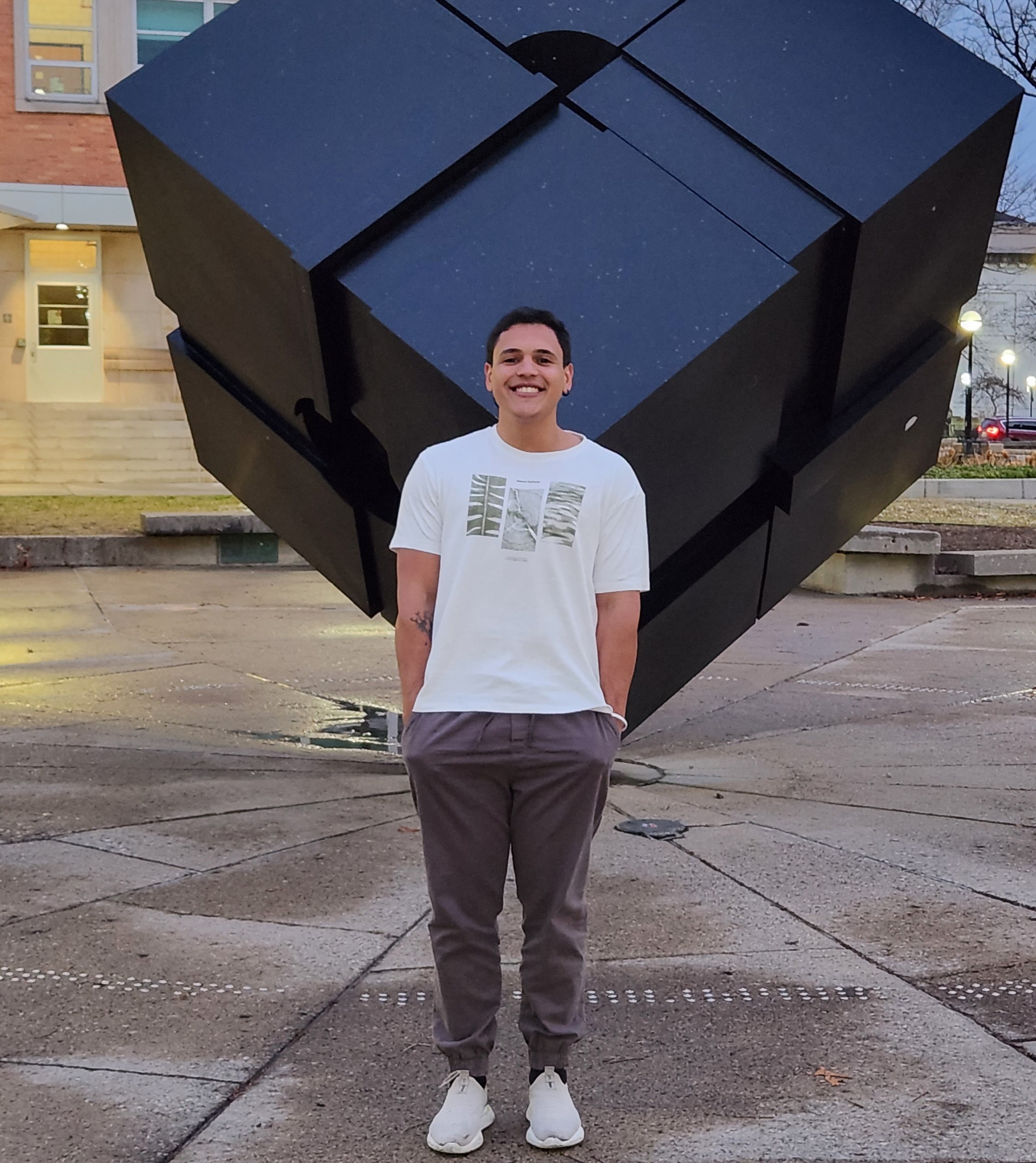
Phelipe Darc
I am an astrostatistics scientist currently pursuing a PhD focused on discovering, classifying, and characterizing explosive astrophysical phenomena using multimodal data, including images, light curves, and spectra. My research focuses on the electromagnetic counterparts of compact-object mergers, including kilonovae from neutron star–black hole and neutron star–neutron star mergers and predicted emission from binary black holes embedded in AGN disks. My work combines theoretical modeling, machine learning, and simulation-based inference to understand the most energetic transients in the Universe. I also develop physics-informed open-source tools for the multi-messenger astronomy community, enabling rapid candidate vetting, ranking, and follow-up of newly discovered multimessenger events.
Research
An open-source framework for scoring optical transient candidates against a kilonova model grid in real time, deployed into TROVE (Tool for Rapid Object Vetting and Examination) — a community coordination platform for multimessenger follow-up. The framework enables rapid candidate vetting using simulation-based statistical diagnostics, making it suitable for alert-driven environments such as LSST brokers and gravitational-wave follow-up infrastructures.
Building amortized Bayesian pipelines using Neural Posterior Estimation, Neural Likelihood Estimation, and sequential likelihood-free methods to rapidly infer physical parameters from spectral and light curve data. Validated on AT2017gfo and GRB230307A.
Leading optical and spectroscopic follow-up of LIGO/Virgo/KAGRA binary black hole merger candidates (S231206cc & S240413p), testing whether mergers embedded in AGN accretion disks generate observable electromagnetic flares. This work combines transient discovery pipelines, physical modeling, BBH simulations and observational campaigns to probe one of the most promising channels for finding EM counterparts to BBH events ("Dark Flares").
As part of the CBPF LAB-IA group, developing the Astronomical Data Smart System, a next-generation platform for real-time transient discovery, alert filtering, and rapid physical inference in the LSST era. In parallel, contributing to AI-Scope, a community portal tailored for astronomers to query major sky surveys, access databases, explore catalogs, and build AI workflows for data analysis. Together, these tools bridge modern artificial intelligence with practical research infrastructure for the astronomy community.
TEGLON: an open-source Python framework for GW follow-up. TEGLON ingests LVK HEALPix sky maps, applies galaxy-catalog completeness weighting, redistributes localization probability, and generates optimized telescope tiling plans. The pipeline supports both rapid target-of-opportunity campaigns and detectability analyses, with extensions for binary black hole events and AGN-host prioritization. I contributed to the development of the documentation, article, and extension to EM counterparts to BBH events.
Member of COIN — a worldwide interdisciplinary network building data-driven solutions across astrophysics. Current COIN contributions include: i) SAGUI, SED-based segmentation of multi-band galaxy images; ii) an archival search for intermediate-mass black hole tidal disruption events in 62,189 elliptical galaxies using ZTF. COIN projects span statistical methodology, machine learning, and open-source tool development for the global astronomy community.
Publications
Curriculum Vitae
Supervisor: Clecio R. De Bom
Developed and submitted KilonovaSCORER to PASP — real-time kilonova ranking framework for GW follow-up
NLP / BERTimbau / Symptoms classification
I am currently a Ph.D. candidate at CBPF, actively seeking postdoctoral opportunities in astrophysics, multi-messenger astronomy, or machine learning applied to physical sciences. I welcome opportunities to collaborate on challenging open problems at the intersection of AI and astrophysics.
Rio de Janeiro, Brazil